The Champions League is the biggest club competition in world football. Yet since 2024, it has looked very different. This guide explains the new Champions League format step by step, from the league phase to the final. So if the table with 36 clubs confuses you, read on.
Why the Champions League format changed
For two decades, the tournament used a simple group stage. Then 32 clubs played in eight groups of four, and the top two from each group went through.
However, UEFA wanted more big games and fewer dead matches. So from the 2024–25 season, it switched to a new Champions League format with one single league of 36 clubs. Many people call it the Swiss model, because the idea comes from Swiss-system chess tournaments.
How the league phase works
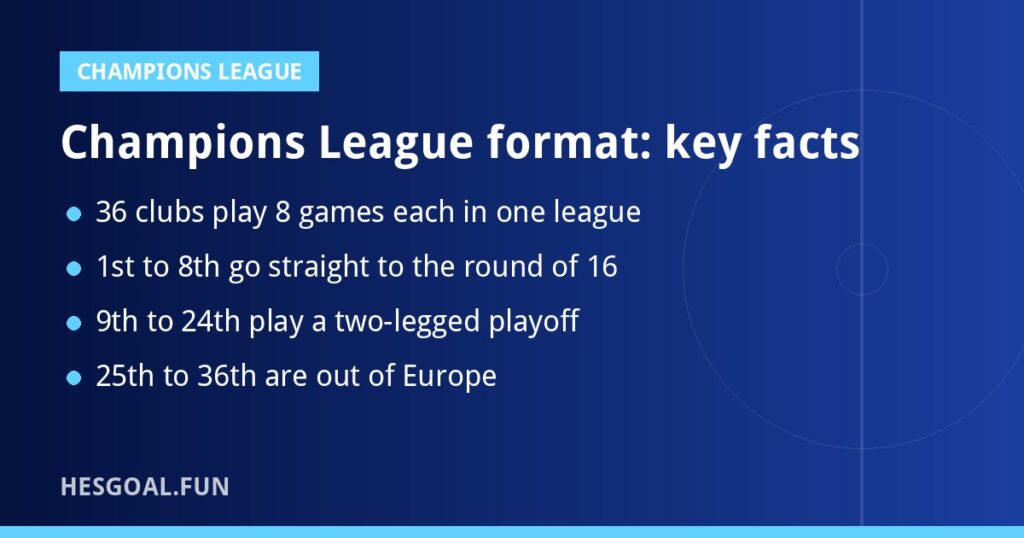
The league phase is the heart of the new Champions League format. First, the 36 clubs go into four pots of nine, based on their UEFA ranking. Then each club draws two opponents from every pot. As a result, every club plays eight different opponents: four at home and four away.
All 36 clubs then sit in one big table. A win earns 3 points and a draw earns 1 point. Because every club faces a different schedule, the draw can make a big difference to a club’s chances.
What happens after the league phase?
When the eight matchdays end, the table splits into three groups:
- 1st to 8th: these clubs go straight into the round of 16.
- 9th to 24th: these clubs enter a knockout playoff over two legs. The eight winners join the round of 16.
- 25th to 36th: these clubs go out of Europe completely.
Under the old system, third place in a group meant a drop into the Europa League. Now, though, there is no safety net for the clubs at the bottom. Also, a top-eight finish matters a lot, since those clubs skip the playoff and get extra rest.
The knockout rounds
From the round of 16 onwards, the Champions League format looks familiar. Each tie has two legs, one at each club’s stadium. The team that scores more goals over both games goes through.
The away goals rule no longer exists. UEFA scrapped it in 2021. So if the scores are level after two legs, the tie goes to extra time and then, if needed, a penalty shootout.
The quarter-finals and semi-finals follow the same pattern. Finally, the two last clubs meet in a single final at a neutral stadium, which UEFA picks years in advance.
How clubs qualify
Most clubs earn a place through their domestic league. The strongest leagues, such as the Premier League and La Liga, usually send four clubs each.
In addition, the new Champions League format adds two bonus places each season. They go to the two countries whose clubs did best in Europe the season before. That is why a fifth-placed team in England or Spain can sometimes qualify. The title holders also get a place, as do the Europa League winners.
When the games take place
Most Champions League nights fall on a Tuesday or a Wednesday. The league phase usually runs from September to January. After that, the knockout rounds fill the spring, and the final takes place in late May or early June.
Is the new Champions League format better?
Opinions differ. On the plus side, fans get more meetings between top clubs, and far more games still matter on the last matchday. In fact, the final night of the league phase now brings many matches at the same time, with the whole table changing minute by minute.
On the other hand, the extra games add to an already crowded calendar. Many players and coaches worry about fatigue. Still, the early seasons have produced plenty of drama, which is exactly what UEFA wanted.
Champions League format: a quick recap
To sum up, the Champions League format now has 36 clubs in one league, eight games each, a playoff round for 9th to 24th, and knockouts from the last 16. For the official rules and the latest table, visit the UEFA Champions League website. Then read about the clubs that have lifted the trophy most often.