Real Madrid against Barcelona is more than a football match. It is a clash of cities, cultures and footballing ideas that has gripped Spain for over a century. In this guide, we walk through El Clásico history, from the first meeting in 1902 to the rivalry that the whole world watches today.
Where El Clásico history begins
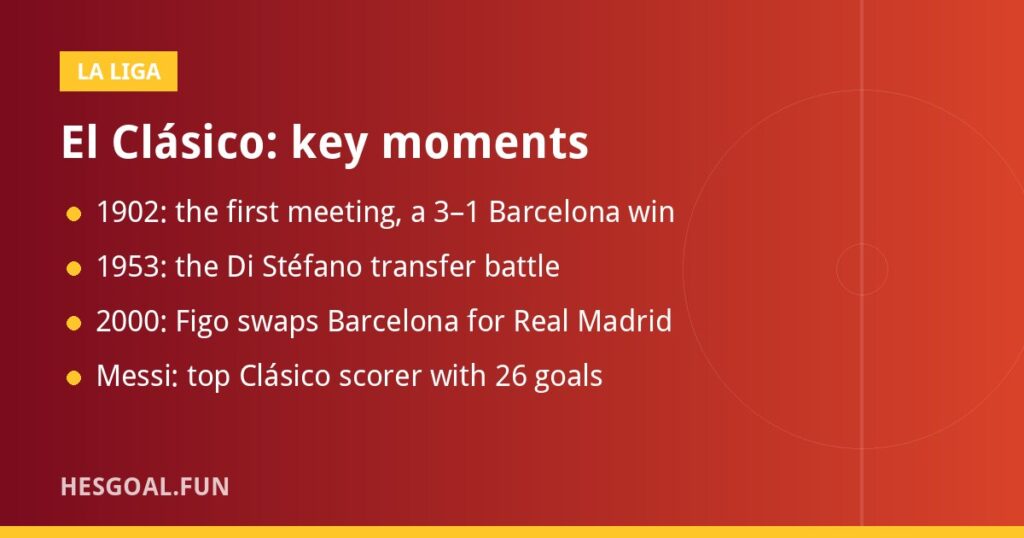
The two clubs first met in 1902, in a cup competition in Madrid. Barcelona won that game 3–1. At the time, nobody could have guessed how big the rivalry would become.
When La Liga started in 1929, the fixture became a regular part of the calendar. From then on, the two giants met at least twice every season. Since neither club has ever dropped out of the top flight, that tradition has never stopped.
Why the rivalry runs so deep
El Clásico history is not only about football. Madrid is the capital of Spain, while Barcelona is the heart of Catalonia, a region with its own language and a strong identity. So for many fans, the match also stands for a wider debate about Spanish and Catalan identity.
Politics shaped the rivalry during the 20th century too. For example, in 1943 Real Madrid beat Barcelona 11–1 in a cup semi-final. Even today, fans still argue about the pressure that surrounded that game.
The transfer battles
Some of the most bitter chapters in El Clásico history happened off the pitch. In 1953, both clubs claimed to have signed the Argentine star Alfredo Di Stéfano. After a long dispute, he joined Real Madrid. He then led them to five European Cups in a row, while Barcelona could only watch.
Decades later, the roles changed. In 2000, Luís Figo left Barcelona and joined Real Madrid. Barcelona fans felt betrayed. When he returned to the Camp Nou in 2002, someone in the crowd even threw a pig’s head onto the pitch near him.
Legendary nights in El Clásico history
Every fan has a favourite Clásico. Still, a few games stand above the rest:
- 2005: Ronaldinho scored twice in a 3–0 win at the Bernabéu, and the Real Madrid fans stood up to applaud him.
- 2009: Barcelona won 6–2 in Madrid, one of the biggest away wins in the history of the fixture.
- 2010: Pep Guardiola’s Barcelona beat José Mourinho’s Real Madrid 5–0 at the Camp Nou.
- 2017: Lionel Messi scored a late winner in a 3–2 thriller in Madrid, then held up his shirt to the crowd.
Messi against Ronaldo
From 2009 to 2018, El Clásico became a personal duel. Lionel Messi led Barcelona, while Cristiano Ronaldo led Real Madrid. Between them, they won almost every major individual award of that era.
Messi finished as the top scorer in El Clásico history, with 26 goals against Real Madrid. Ronaldo, meanwhile, scored 18 times against Barcelona. Because the two stars met so often, many fans call that decade the greatest period the fixture has ever seen.
Who has won more?
The head-to-head record is remarkably close. Over more than 250 official meetings, the lead has changed hands several times. As a result, both sets of fans can always find a statistic to support their side.
In titles, Real Madrid have won the most La Liga crowns, with Barcelona in second place. However, the two clubs together have won the league in most seasons since 1929. For a full breakdown of the current numbers, the official La Liga website keeps up-to-date records.
El Clásico today
Today, El Clásico reaches hundreds of millions of viewers around the world. New stars now carry the rivalry forward, while both clubs keep building for the future.
The matches still decide titles too. Because Spain uses head-to-head results as its first tie-breaker, a single Clásico can settle the league. You can learn more about that rule in our guide to how Spanish football works.
Why El Clásico history still matters
Every new Clásico adds another page to a story that started in 1902. That is why El Clásico history matters so much to fans on both sides. It is a story of legends, transfers, politics and unforgettable goals. For more stories from Spain, visit our La Liga section.