Real Madrid’s trophies and global fame dominate the Spanish capital. Atlético Madrid history tells a different kind of story, one built on resilience, hard work and a fiercely loyal fan base. This guide covers Atlético Madrid history from its founding as a branch of a Basque club to its rise as one of the most respected teams in Europe.
Atlético Madrid history: founding and early identity
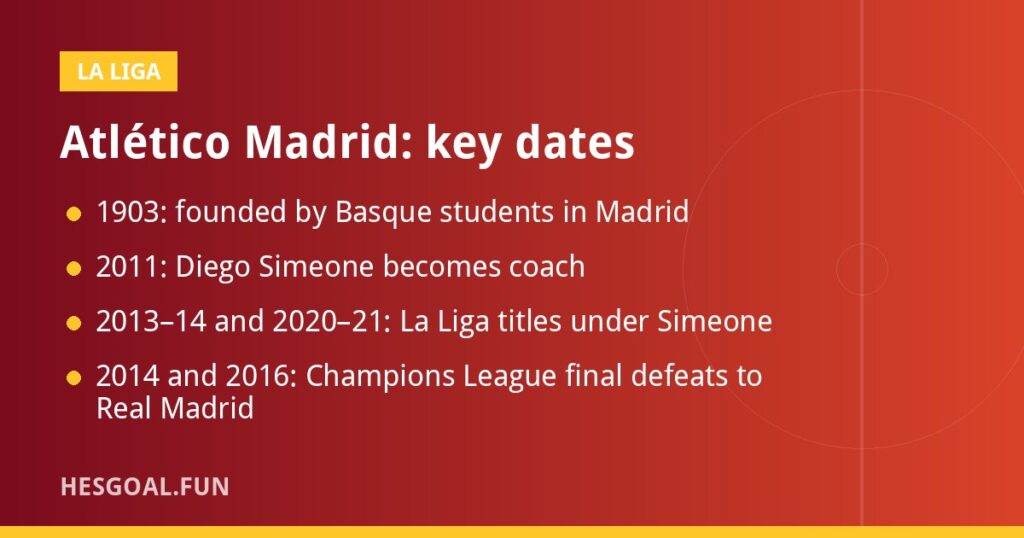
Atlético Madrid began in 1903, when a group of Basque students living in Madrid founded a club as an offshoot of Athletic Club of Bilbao. For years, the Madrid branch and the Bilbao club shared close ties, including similar colours and, at times, players moving between them.
Over time, the Madrid club developed its own separate identity, eventually adopting the name Club Atlético de Madrid. Its red and white striped shirts date back to the early 20th century. The stripes resembled the fabric used on Spanish mattresses at the time, which gave rise to the fond nickname los colchoneros, or the mattress makers.
Life in the shadow of a giant
For much of the 20th century, Atlético Madrid played second fiddle to their more famous neighbours. Real Madrid amassed European Cups and global superstars from the 1950s onward. Meanwhile, Atlético built a reputation as a club of resilience, closer to Madrid’s working-class identity. Still, this was no minor club. Atlético won the Spanish league title several times across the mid-20th century, including a run of championships in the 1940s and 1950s.
The Vicente Calderón years
Atlético played for 50 years at the Vicente Calderón stadium, beside the Manzanares river, from 1966 until 2017. The stadium, named after a former club president, became synonymous with Atlético’s identity during some of its most competitive decades. That era included a La Liga title in 1995–96 and a run to the 1974 European Cup final.
In 2017, the club moved to a new, larger home in the east of Madrid, the Wanda Metropolitano. The move gave Atlético a modern stadium to match its growing ambitions.
The Diego Simeone era
No period in Atlético Madrid’s history has been more transformative than the arrival of Diego Simeone as coach in December 2011. A former Atlético player known for his fierce competitiveness, Simeone built a team defined by defensive organisation, physical intensity and relentless work rate.
Under Simeone, Atlético won La Liga in 2013–14, a title that ended a period of Real Madrid and Barcelona dominance in Spain. The club also reached two Champions League finals during his tenure, in 2014 and 2016, both against city rivals Real Madrid, though they lost both. A second league title followed in 2020–21.
Continental success
While the Champions League has eluded Atlético, the club has enjoyed considerable success in Europe’s second-tier competition. The club has won the Europa League multiple times, along with the UEFA Super Cup. That gives it a strong record in continental competition, even without the biggest prize of all.
The fan culture
Atlético’s supporters are known for their passionate, often fatalistic devotion to the club. They embrace struggle as part of the club’s identity, rather than something to hide from. Fans often use the phrase “sufrir”, meaning suffering, to describe the experience of following the team. For them, it is a badge of honour, not a complaint.
Atlético Madrid history today
Today’s chapter of Atlético Madrid history sees the club standing as one of Spanish football’s three traditional powers, alongside Real Madrid and Barcelona. It competes regularly for both the league title and Champions League qualification. Its rivalry with Real Madrid, the Madrid derby, remains one of the most intense fixtures in world football, which we cover in detail in our guide to the Madrid derby.
To learn more about Spanish football’s structure, read our guide to the La Liga format, or visit the official Atlético Madrid website. You can also browse our La Liga section.