The NBA regular season builds the ladder, but the playoffs decide the champion. Sixteen teams enter, and only one lifts the trophy after a gauntlet of best-of-seven series. This guide walks through how the NBA playoffs work, from seeding to home-court advantage to the Finals.
Which teams make the NBA playoffs each year?
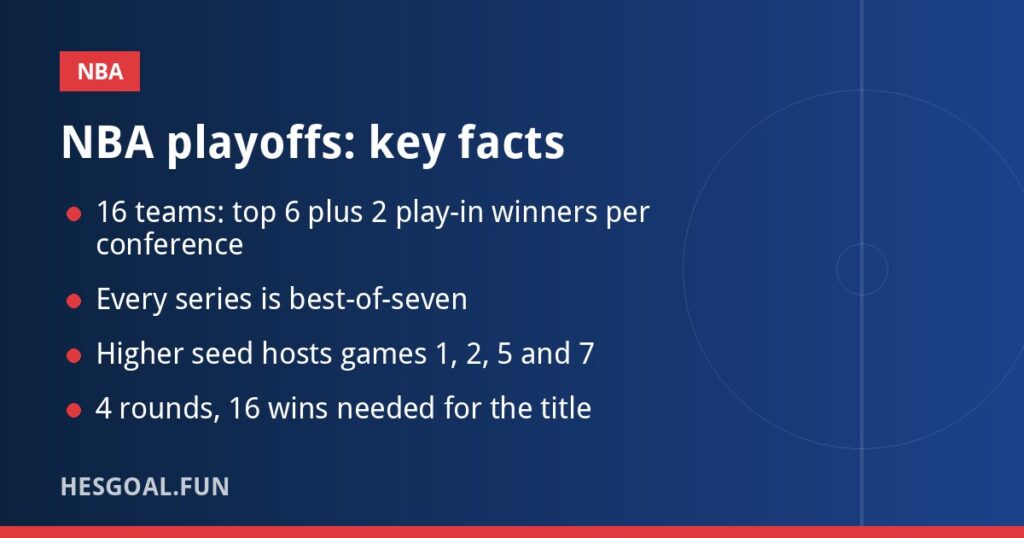
Sixteen teams qualify for the NBA playoffs each year, eight from the Eastern Conference and eight from the Western Conference. The top six teams in each conference, based on regular season record, qualify directly. The remaining two playoff spots in each conference go to the winners of the play-in tournament. That tournament involves the teams that finished seventh through tenth.
How seeding works
Once the sixteen teams are set, each conference seeds its teams one through eight, based on regular season record. The bracket then pairs the highest seed against the lowest. So the 1 seed plays the 8 seed, the 2 seed plays the 7 seed, the 3 seed plays the 6 seed, and the 4 seed plays the 5 seed. In theory, this rewards the best regular season teams with the easiest possible first-round opponent. In practice, though, upsets happen regularly.
Best-of-seven series
Every series in the NBA playoffs is best-of-seven. The first team to win four games advances, and the other team’s season ends. Because it can take seven games to settle a series, the playoffs stretch out over about two months. In theory, though, each round could finish in as few as four games.
Home-court advantage
The team with the better regular season record earns home-court advantage in each series. Under the current format, that team hosts games one, two, five and seven. Meanwhile, the lower seed hosts games three, four and six. Home-court advantage matters enormously in a close series, since it guarantees an extra home game if the series goes the distance. After all, playing in front of a hostile road crowd is genuinely difficult, even for elite teams.
The four rounds
The NBA playoffs unfold across four rounds:
- First round: eight series per conference bracket, reduced to four winners.
- Conference semifinals: four series total, reduced to two winners per conference.
- Conference finals: one series per conference, producing the Eastern and Western Conference champions.
- NBA Finals: the two conference champions meet for the title.
Each round is best-of-seven. So a team must win 16 games across four series to become champion, a demanding test of both talent and depth.
Why depth matters more in the playoffs
Regular season rotations often shrink in the playoffs. Coaches lean more heavily on their best players and trust fewer bench players in high-stakes moments. Injuries also become more costly. After all, a best-of-seven format gives opponents time to adjust their game plan once they identify a weakness. This is why teams with multiple stars and reliable role players often outperform teams that rely on a single dominant scorer.
The play-in tournament’s role
The NBA playoffs technically begin with the play-in tournament, a mini knockout stage for the teams ranked seventh through tenth in each conference. We describe it in more detail in our guide to the NBA season format. The play-in adds late-season stakes for teams on the playoff bubble. It also gives fans of mid-table teams something to play for right until the final week of the regular season.
Momentum and matchups in the NBA playoffs
Unlike a single knockout game, a seven-game series rewards teams that can make in-series adjustments. Coaches study film between games and often make major tactical changes after game one or two. Because of this, the team that wins game one does not always win the series. In fact, some of the most memorable playoff runs have included teams that lost early games before finding their rhythm.
Watching this year’s NBA playoffs
The playoffs run from mid-April through June, culminating in the NBA Finals. For the current bracket and schedule, visit the official NBA website. You can also read more in our NBA section.