El Clásico gets most of the headlines, but Spain’s capital has a fierce rivalry of its own. When Real Madrid meet Atlético Madrid, the whole city takes sides. This guide explains the history of the Madrid derby, its greatest moments and why it means so much to both sets of fans.
Two clubs, one city
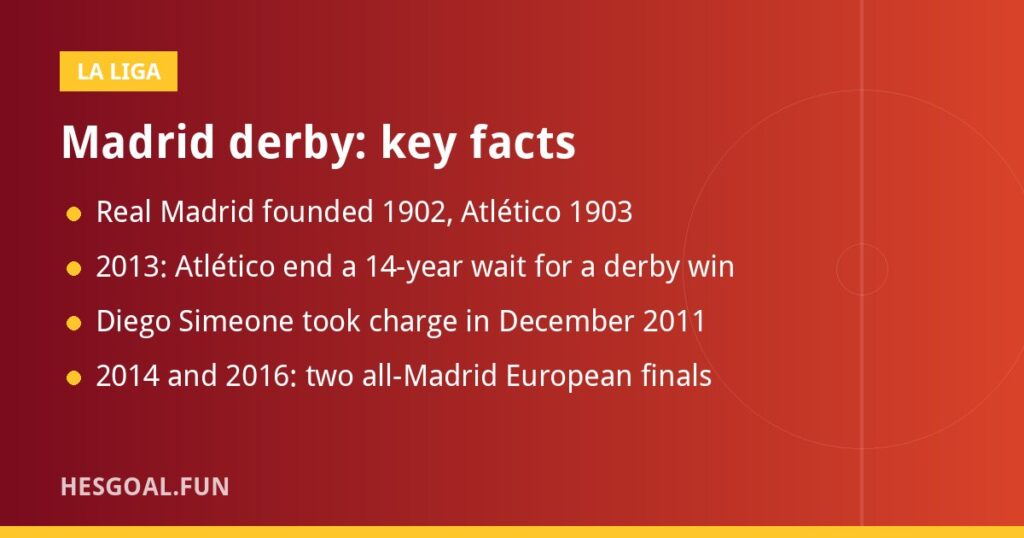
Real Madrid formed in 1902. A year later, in 1903, a group of Basque students in the city founded Atlético as a branch of Athletic Club of Bilbao. Over time, the Madrid club went its own way and built its own identity.
Both clubs play in La Liga, so the Madrid derby takes place at least twice a season. Often, the two sides also meet in cup competitions and in Europe.
Different identities
For much of the 20th century, fans saw the two clubs very differently. Real Madrid had the reputation of the rich, successful establishment club. Atlético, on the other hand, saw itself as the club of ordinary, working-class Madrileños.
Atlético fans even have a nickname from those days: los colchoneros, or the mattress makers. It comes from the club’s red and white stripes, which looked like the fabric on old mattresses. Real Madrid fans, meanwhile, go by los merengues, after the club’s all-white kit.
Home grounds
Real Madrid play at the Santiago Bernabéu in the north of the city. Atlético played for 50 years at the Vicente Calderón, beside the Manzanares river. Then, in 2017, they moved to the Metropolitano, a modern stadium in the east of Madrid.
A lopsided Madrid derby for decades
For a long time, the Madrid derby was not an equal contest. Real Madrid won far more trophies and far more derbies. In fact, from 1999 to 2013, Atlético failed to beat their neighbours in any competition.
That run finally ended in the 2013 Copa del Rey final. Atlético won 2–1 after extra time, and they did it at the Bernabéu.
The Simeone effect
The man behind that change was Diego Simeone. A former Atlético player, he became coach in December 2011. He built a tough, organised and hard-working team that could beat anyone on its day.
Under Simeone, Atlético won La Liga in 2013–14 and again in 2020–21. As a result, the Madrid derby became a real battle between two top teams.
Heartbreak in Europe
The most painful chapters for Atlético came in Champions League finals. In 2014, in Lisbon, Atlético led Real Madrid 1–0 until the 93rd minute. Then Sergio Ramos headed an equaliser, and Real won 4–1 after extra time.
Two years later, the two clubs met again in the final in Milan. This time, the game went to penalties, and Real Madrid won once more. For Atlético fans, those two nights still hurt.
The Madrid derby today
Today, the Madrid derby is one of the most intense fixtures in world football. Games are often tight, physical and full of drama. Also, both clubs now compete regularly in the Champions League, so a derby can decide a European tie as well as a league title.
Why the Madrid derby matters
For Real Madrid, the Madrid derby is a chance to prove who rules the capital. For Atlético, it is a chance to show that hard work can beat money and glamour. That contrast is what makes the rivalry so compelling.
To learn more about Spanish football, read our guide to how La Liga works or the full story of Real Madrid’s history. You can also find official fixtures on the La Liga website, or browse our La Liga section.