The atmosphere inside English grounds is one of the main reasons fans love the league. Some stadiums are more than a century old, while others opened only a few years ago. In this guide, we tour the most famous Premier League stadiums and explain what makes each one special.
Old Trafford, Manchester United
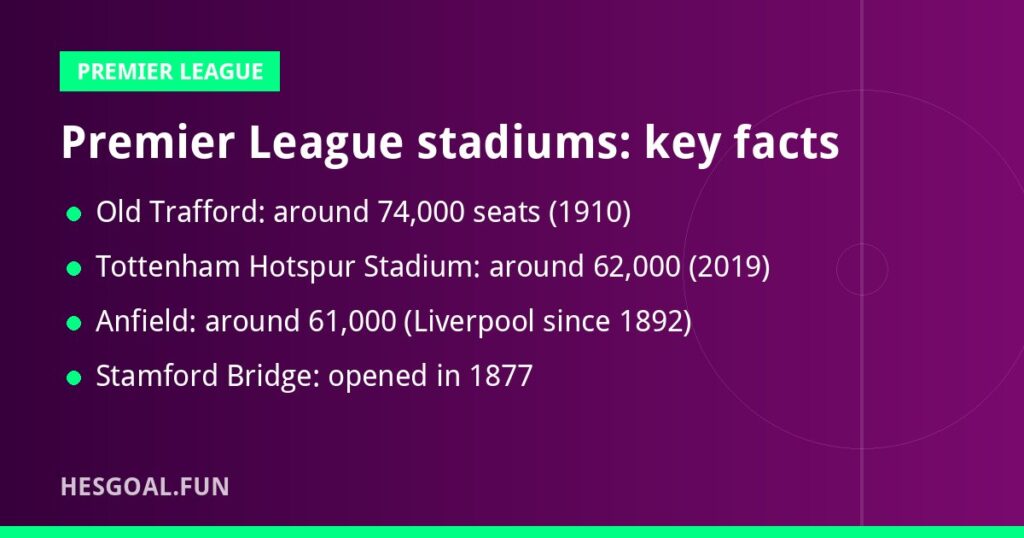
Old Trafford opened in 1910. Today it holds around 74,000 fans, which makes it the largest club stadium in England. Sir Bobby Charlton gave it its famous nickname, the Theatre of Dreams.
However, the ground is showing its age. So in 2025, the club announced plans to build a brand-new stadium next to the current site.
Anfield, Liverpool
Anfield has been Liverpool’s home since the club was founded in 1892. It is best known for the Kop, a huge single stand behind one goal. Before every game, the crowd sings You’ll Never Walk Alone, a moment that gives many visitors goosebumps.
After recent expansions, Anfield now holds around 61,000 people. Also, few Premier League stadiums can match its noise on big European nights.
The Emirates Stadium, Arsenal
Arsenal moved to the Emirates Stadium in 2006, after 93 years at Highbury. The new ground holds around 60,000 fans. Meanwhile, the club turned its old home into apartments, keeping the famous art deco facade.
Tottenham Hotspur Stadium: a modern landmark among Premier League stadiums
Opened in 2019, the Tottenham Hotspur Stadium is one of the most modern Premier League stadiums. It holds around 62,000 fans. It also has a steep single-tier South Stand, which the club designed to create a wall of sound.
The stadium even has a retractable pitch. Because of this, it can host NFL games on an artificial surface without damaging the grass.
The Etihad Stadium, Manchester City
The Etihad Stadium first opened for the 2002 Commonwealth Games. Then Manchester City moved in a year later. Since then, the club has expanded it several times, as the team’s success brought bigger crowds.
St James’ Park, Newcastle United
St James’ Park sits right in the middle of Newcastle, on a hill above the city centre. It holds around 52,000 fans. Because it stands so close to the city, match days fill the streets with black and white shirts.
Stamford Bridge, Chelsea
Stamford Bridge opened in 1877, even before Chelsea existed. The club formed in 1905 partly because the ground needed a team. With around 40,000 seats, it is small for a club of Chelsea’s size. So the question of a bigger home comes up again and again.
New Premier League stadiums for historic clubs
Several clubs have moved in recent years. For example, West Ham United left the Boleyn Ground in 2016 for the London Stadium, the main venue of the 2012 Olympic Games.
In 2025, Everton also said goodbye to Goodison Park after 133 years. The club moved to a new stadium on the banks of the River Mersey at Bramley-Moore Dock.
What makes Premier League stadiums special?
Three things set Premier League stadiums apart. First, the fans sit close to the pitch, because English grounds rarely have running tracks. Second, many stadiums sit inside cities, so they feel like part of the local community. Finally, the history of each ground adds meaning to every match.
All Premier League stadiums have also been all-seater since the 1990s, following the Taylor Report. Recently, though, the league has allowed special safe standing areas at several grounds.
Visiting Premier League stadiums
Most clubs offer stadium tours on non-match days. Tours usually include the dressing rooms, the tunnel and the club museum. You can find tour dates and tickets on each club’s official website, which you can reach from the Premier League clubs page.
Want to know more about the clubs that play in these grounds? Read our guide to the six biggest clubs in England, or explore more Premier League guides.