FC Barcelona calls itself Més que un club, which means more than a club. For its fans, the team stands for Catalan identity, a special style of football and a famous youth academy. This guide covers Barcelona history from its founding in 1899 to the era of Messi and beyond.
How Barcelona history began
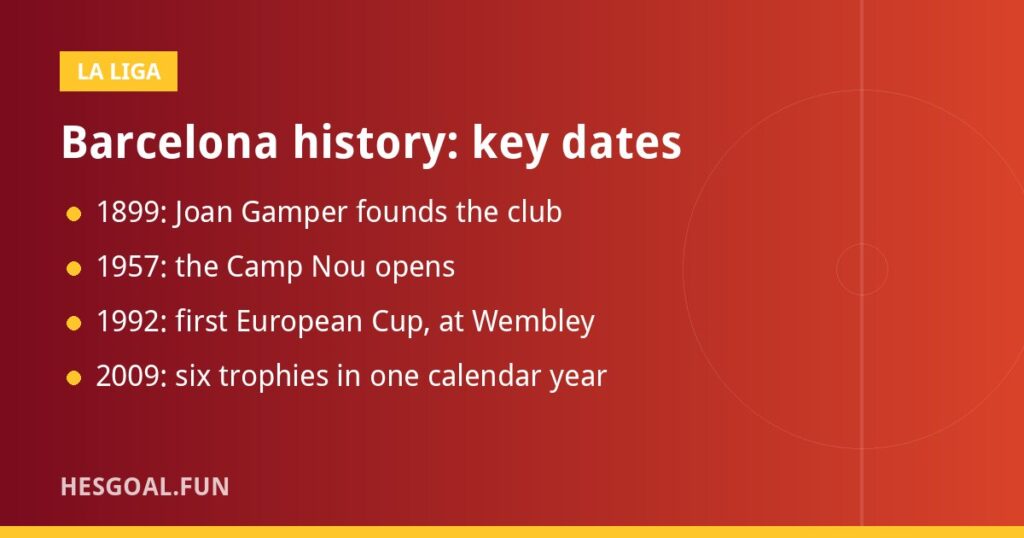
On 29 November 1899, a Swiss businessman named Joan Gamper placed an advert in a local newspaper. He was looking for players to start a new football club. A small group answered, and FC Barcelona was born.
Gamper went on to lead the club for many years. Also, the club’s colours, blue and deep red, known as blaugrana, came from those early days.
A club owned by its members
Unlike many big clubs, Barcelona has no single owner. Instead, its members, called socis, own the club. Every few years, they vote to elect the club president.
This model shapes Barcelona history in many ways. For example, the club did not put a commercial sponsor on its shirts until 2011. Before that, from 2006, the shirts carried the UNICEF logo, and the club paid the charity for the privilege.
The Camp Nou
In 1957, Barcelona opened the Camp Nou, which became the largest stadium in Europe. For decades, it was the stage for the club’s greatest nights. Then, in 2023, the club began a major rebuild of the stadium to make it bigger and more modern.
Johan Cruyff changes Barcelona history
No single person shaped modern Barcelona history more than Johan Cruyff. First, he joined as a player in 1973. That season, Barcelona won the league for the first time in 14 years, and they even beat Real Madrid 5–0 in Madrid.
Later, Cruyff returned as coach in 1988. He built the Dream Team, which played attacking, passing football. In 1992, that team won Barcelona’s first European Cup at Wembley, thanks to a Ronald Koeman free kick.
La Masia
Cruyff also pushed the club to develop its own players. Its academy, La Masia, went on to produce some of the best players of all time, including Xavi, Andrés Iniesta, Carles Puyol, Sergio Busquets and Lionel Messi.
Messi joined the academy from Argentina at the age of 13. Remarkably, the club first offered him a contract on a paper napkin.
The Guardiola years
Pep Guardiola, a La Masia graduate and former Barcelona captain, became coach in 2008. In his first full season, the team won six trophies in one calendar year, a feat no club had achieved before.
His teams passed the ball with incredible speed and precision. Many experts still call Guardiola’s Barcelona the greatest club side they have ever seen. In total, it won 14 trophies in four seasons, including two Champions League titles.
MSN and a fifth European title
In 2015, a front three of Messi, Luis Suárez and Neymar led Barcelona to another treble. Fans called them MSN. That season, the club won its fifth European Cup, beating Juventus in the final in Berlin.
Messi’s departure and a new era
In 2021, financial problems forced the club to let Messi leave. He finished as the club’s all-time top scorer, with 672 goals in all competitions. So his exit marked the end of the most successful era in Barcelona history.
Since then, the club has turned back to its academy. A new generation of young players, led by La Masia graduates such as Lamine Yamal, has brought fresh hope.
Why Barcelona history matters
Barcelona history shows how a club can build success on a clear idea: attacking football, homegrown talent and deep local roots. To learn about the club’s greatest rivalry, read our guide to El Clásico, or browse the La Liga section. For official club news, visit the FC Barcelona website.