Before it became the Champions League, Europe’s top club competition had a simpler name: the European Cup. Its early years produced legendary teams, tragic stories and some of the greatest matches ever played. This guide covers European Cup history from its launch in 1955 to the start of the 1970s.
How European Cup history began
The idea came from Gabriel Hanot, a journalist at the French sports newspaper L’Équipe. In the early 1950s, English newspapers claimed that Wolverhampton Wanderers were the best club in the world, after they beat top teams from abroad in friendly games. Hanot disagreed. He argued that a real competition was the only way to find the true champion of Europe.
His newspaper drew up a plan, and UEFA agreed to run the tournament. So the first season began in 1955–56, with 16 clubs.
A missing English champion
Chelsea won the English league in 1955, so they should have played in the first edition. However, the Football League told them not to enter, because it saw the new competition as a distraction. Meanwhile, Hibernian from Scotland did take part, and they reached the semi-finals.
Real Madrid rule the first five years
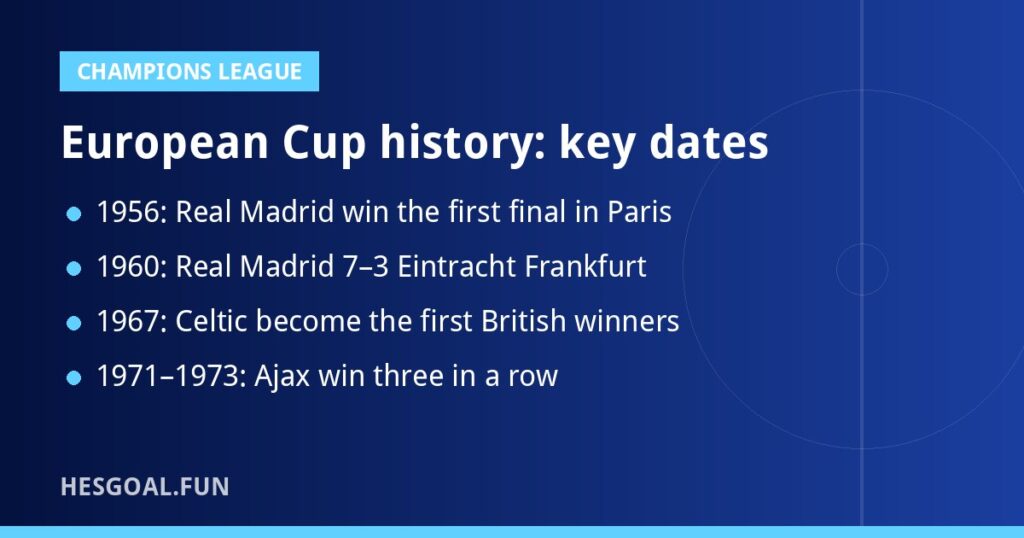
The first final took place in Paris in 1956. Real Madrid beat Stade de Reims 4–3 in a thrilling game. After that, they won the next four finals as well.
Their greatest performance came in 1960 at Hampden Park in Glasgow. In front of more than 127,000 fans, Real Madrid beat Eintracht Frankfurt 7–3. Ferenc Puskás scored four, and Alfredo Di Stéfano scored three. Many fans still call it the greatest final in European Cup history.
Tragedy in Munich: a dark day in European Cup history
Not every story was a happy one. In February 1958, Manchester United were flying home from a European Cup match in Belgrade. Their plane crashed on take-off after a refuelling stop in Munich. The disaster killed 23 people, including eight players.
The manager, Matt Busby, survived his injuries and rebuilt the team. Ten years later, in 1968, United won the European Cup at Wembley, beating Benfica 4–1 after extra time.
Benfica and Inter
In 1961, Benfica ended Real Madrid’s run of success. Then, a year later, they beat Real Madrid 5–3 in the final, with the young Eusébio scoring twice.
Next came Inter Milan. Under the coach Helenio Herrera, Inter won the trophy in 1964 and 1965. His team played a strong defensive style that people often call catenaccio, which means door bolt.
The Lisbon Lions
In 1967, Celtic became the first British club to win the European Cup. They beat Inter 2–1 in Lisbon. Remarkably, almost every player in the team came from within about 30 miles of Celtic’s stadium in Glasgow. Because of that final, fans still call the team the Lisbon Lions.
The Dutch arrive
At the end of the decade, a new force emerged. In 1970, Feyenoord became the first Dutch club to win the trophy. Then Ajax, led by Johan Cruyff, won three finals in a row from 1971 to 1973. Their Total Football style changed the way many teams played.
Why early European Cup history still matters
The early years of European Cup history created the traditions that the Champions League still follows today. They also gave the competition its first legends and its most famous nights.
To see how the modern tournament works, read our guide to the new league phase. For the full list of winners, read about the most successful clubs in Europe, or visit UEFA’s history pages.