Few clubs in any sport can match the success of Real Madrid. The club has won more European Cups than anyone else, and in 2000 FIFA named it the best club of the 20th century. This guide walks through Real Madrid history, from a small club founded in 1902 to a global giant.
The early years of Real Madrid history
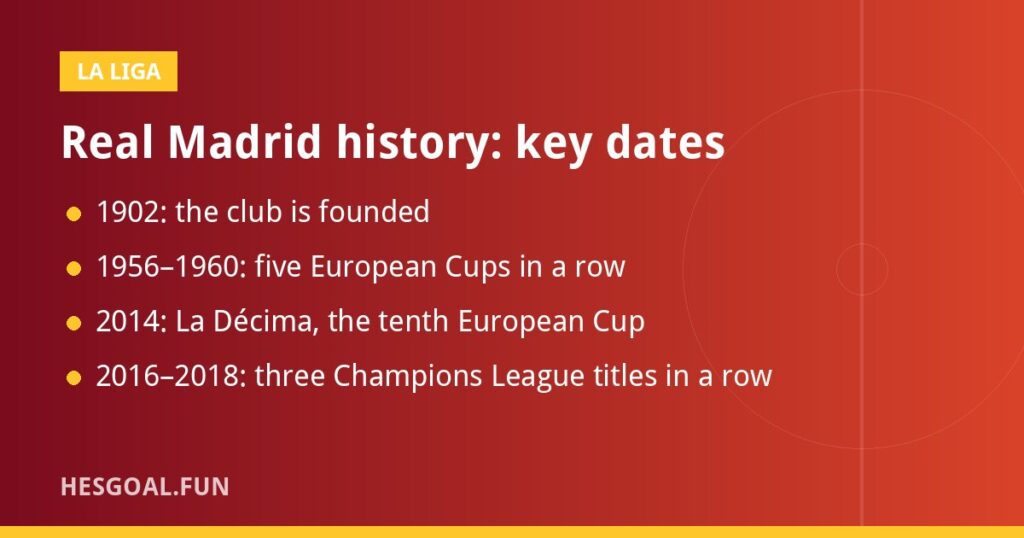
A group of football fans founded Madrid Football Club on 6 March 1902. At first, the club played on simple pitches around the city. Then, in 1920, King Alfonso XIII gave the club the right to use the title Real, which means royal. That is also why the club badge includes a crown.
Santiago Bernabéu builds a giant
The most important figure in Real Madrid history was not a star forward or a coach. Santiago Bernabéu, a former player, became club president in 1943 and stayed until his death in 1978.
First, he built a huge new stadium, which opened in 1947 and later took his name. Then he brought the best players in the world to Madrid. His biggest signing was Alfredo Di Stéfano, who arrived in 1953.
Five European Cups in a row
When the European Cup began in 1955–56, Real Madrid won it. In fact, they won each of the first five editions, from 1956 to 1960. Di Stéfano and the Hungarian forward Ferenc Puskás led the team.
The 1960 final in Glasgow is still one of the greatest games ever played. Real Madrid beat Eintracht Frankfurt 7–3, with Puskás scoring four goals and Di Stéfano three.
The Ye-yé team and the Quinta del Buitre
In 1966, Real Madrid won a sixth European Cup with a team made up entirely of Spanish players. Fans nicknamed that side the Ye-yé team, after a pop music style of the time.
Later, in the 1980s, a group of academy graduates led by Emilio Butragueño formed the Quinta del Buitre. Together, they won five league titles in a row between 1986 and 1990.
The Galácticos
In 2000, Florentino Pérez became president and started a bold new policy. Each summer, he signed one of the biggest stars in world football. Luís Figo came first, then Zinédine Zidane, Ronaldo Nazário and David Beckham.
Fans called these stars the Galácticos. The team won the 2002 Champions League, thanks to a stunning volley from Zidane in the final. However, the project later struggled, because the squad lacked balance.
Cristiano Ronaldo and La Décima
Cristiano Ronaldo joined Real Madrid in 2009. Over the next nine seasons, he scored 450 goals for the club, which makes him its all-time top scorer.
In 2014, Real Madrid finally won their tenth European Cup, a title fans called La Décima. In the final against Atlético Madrid, Sergio Ramos scored a late equaliser, and Real went on to win 4–1 after extra time.
Three in a row under Zidane
Zidane returned as coach in 2016. Then he led the club to three Champions League titles in a row, from 2016 to 2018. No team had done that since the competition took its current name in 1992.
Real Madrid history in the modern era
The success did not stop there. Under Carlo Ancelotti, Real Madrid won the Champions League again in 2022 and 2024. Also, the club rebuilt the Santiago Bernabéu, adding a retractable roof and a retractable pitch. Then, in 2024, Kylian Mbappé joined, continuing the club’s tradition of signing the biggest stars.
Why Real Madrid history matters
Real Madrid history is full of legends, great teams and unforgettable nights. Above all, it shows how ambition at the top of a club can shape a century of success.
To learn about the club’s biggest rivalry, read our guide to the story of Real Madrid vs Barcelona. For more on the club’s trophies, visit the official Real Madrid website. You can also browse our La Liga section.